Folks often have difficulty memorizing the various Hepatitis B serologic markers and their related clinical states. It is imperative that you understand this because it’s one of the most common serologic tests performed in the laboratory. You have undergone this testing if you’ve ever worked/volunteered/trained in a healthcare facility! The chance of coming across a question on the exam is very high. These are easy points.
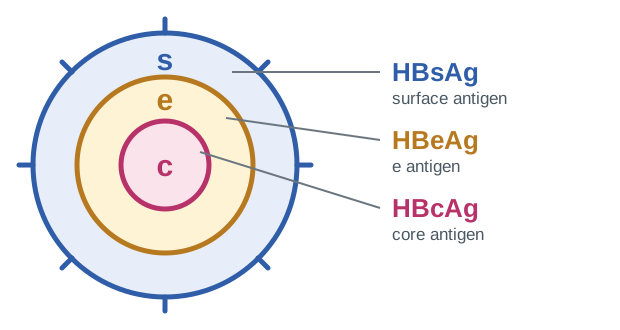
Any lab science review book will explain the details. I only hope to make the memorization palatable. Look at the following diagram of Hepatitis B. It consists of a surface antigen, an e antigen, and a core antigen. Antibodies are formed against these various components at different times - either in the acute, recovery, or chronic phases of infection.
What serologic markers will be seen during…
| Stage | Antigens (Ag) | Antibodies (Ab) |
|---|---|---|
| Acute Hep B infection | HBsAg HBeAg | HBcAb (IgM) HBeAb |
| Recovery from Hep B | none | HBcAb (total) HBeAb HBsAb |
| Chronic carrier of Hep B | HBsAg HBeAg | HBcAb (total) |
| Immunity as a result of vaccination | none | HBsAb |
Acute
s e
anti-c e
Recovery
–
anti-c e s
Chronic
s e
anti-c
memorize this little square and you’ve already put some points in the bank!
Comments